
The Montage Method: Connecting Goals, Strategy, and Execution to Measurable Progress
As businesses grow, they most likely have clear goals, a long project list, productive employees, full calendars, leadership meetings every week, and plenty of metrics to review. However, the owner might still be wondering why the important priorities never seem to move fast enough.
We often find that a business’s goals, scorecards, strategies, projects, and to-dos are being treated as if they are interchangeable or managed separately without a clear connection between them. When those layers blur together, activity might increase but visibility into progress decreases. This makes it difficult to tell whether the company is pursuing the right outcome, measuring the right things, following a coherent strategy, executing the necessary projects, or simply staying busy.
For a founder trying to reduce their involvement in the business, that ambiguity creates an even bigger problem that can actually result in more founder dependency.
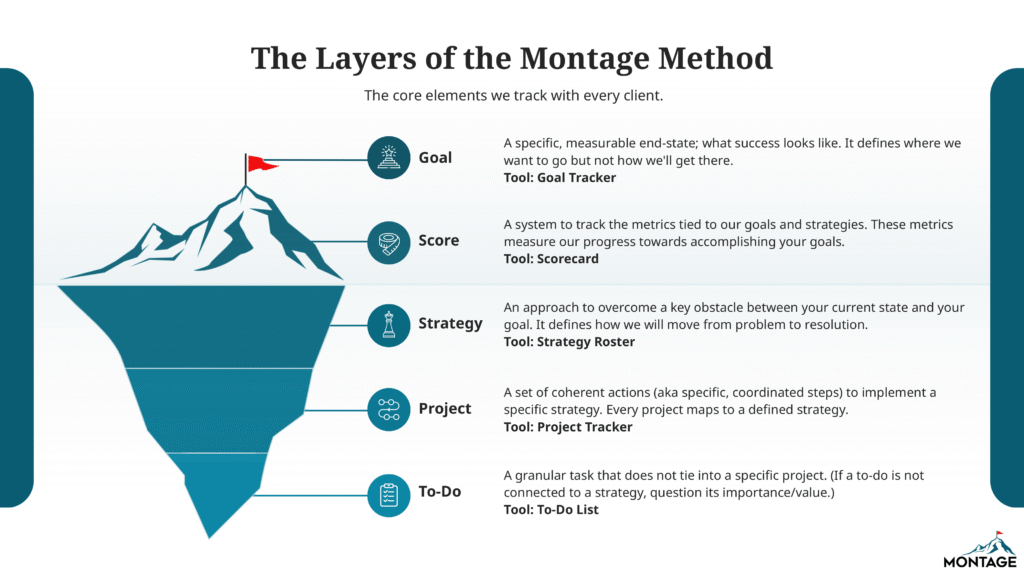
The Montage Method is designed to create clarity between these different layers of execution. Each layer has a specific purpose, and each has a corresponding tool that allows leadership to see how priorities translate into measurable progress. Below we’ll dive into the goals, scorecards, strategies, projects, and to-do’s that keep your business on track.
A Goal Defines the Outcome
A goal answers a relatively simple question: What are we trying to accomplish?
In the Montage Method, a goal is a specific, measurable end-state. It defines what success looks like and where the business wants to go, but it does not explain how the company will get there.
For example, a company might want to reduce customer churn, improve gross margin, decrease the amount of operational decision-making that reaches the owner, or prepare the business to operate without the founder’s daily involvement.
The goal gives the organization something to orient around, but a goal does not explain how the company will achieve it.
This matters because leadership teams frequently jump directly from goals to action. They identify an outcome, brainstorm a list of things they could do, assign some tasks, and assume they now have a plan. And while it’s great to start with a goal, that doesn’t mean you are ready to start acting on it just yet.
Within the Montage Method, goals are maintained in the Goal Tracker so the desired end-state remains clear and measurable.
A Scorecard Measures Progress Toward the Goal
Once the goal is clear, the next question is: How will we know whether we’re making progress? This is where the Scorecard comes in.
In the Montage Method, the Scorecard tracks the metrics tied to your goals and strategies. These metrics give leadership an objective way to determine whether the business is moving toward the desired outcome instead of relying on activity, anecdotal updates, or gut feel.
Continuing with the founder-dependency example, the company might track the number of operational decisions escalated to the founder each week, the founder’s hours spent on day-to-day operational issues, or the percentage of recurring decisions handled independently by the leadership team.
The Scorecard does not tell the company what to do. It tells leadership whether what they’re doing is producing progress. This is necessary because businesses often have plenty of metrics without having meaningful visibility. The purpose is to identify the measures that help you determine whether your goals and strategies are actually working.
Within the Montage Method, these metrics are maintained in the Scorecard and reviewed as part of the operating cadence.
A Strategy Defines How You Intend to Reach the Goal
Strategy answers a different question: What obstacle is standing between where we are and where we want to go, and how are we going to overcome it?
In the Montage Method, a strategy is an approach for overcoming a key obstacle between the current state of the business and the goal. It defines how the company intends to move from problem to resolution.
If the goal is to reduce founder dependency, leadership might identify one of the primary obstacles as recurring operational decisions continuing to escalate to the founder. The strategy could be to transfer those decisions to functional leaders using clearly defined decision authority, performance measures, and escalation rules.
It’s a more useful and actionable plan than simply saying, “Delegate more.” A strategy creates direction by making choices. It should clarify the problem being addressed, where the organization will focus, and the approach it believes will move the business closer to the goal.
This is where many companies have a hidden execution problem. They have goals at the top and projects underneath them, but the strategic layer between the two is weak or missing.
Without that layer, projects are often selected because they sound useful rather than because they advance a deliberate approach. Six months later, everyone has been busy, but leadership has difficulty explaining how all that work materially changed the business or progressed toward the goal.
Within the Montage Method, active strategies are maintained in the Strategy Roster so leadership can clearly see which obstacles are being addressed and how.
A Project Turns Strategy Into a Defined Piece of Work
Once the strategy is clear, projects answer: What needs to be completed or changed to execute this strategy?
In the Montage Method, a project is a set of coherent actions, meaning specific, coordinated steps that collectively implement a strategy. Every project should map back to a defined strategy.
Continuing the founder-dependency example, the company might decide to build and implement a decision-rights framework for its leadership team.
That is a project.
It should have a defined outcome. It should have an owner. It should have a reasonable timeframe. And when it is finished, something about how the business operates should be different.
The coordinated actions within that project might include documenting the recurring decisions currently escalating to the founder, assigning decision authority to the appropriate functional leaders, defining escalation criteria, and rolling out the new framework to the leadership team.
The important point is that projects should trace upward, and that multiple projects can be used to advance a strategy. You should be able to look at an important project and answer, “Which strategy does this support?” You should then be able to look at that strategy and answer, “Which goal does this advance?”
Within the Montage Method, projects are maintained in the Project Tracker so leadership can see what is being executed, who owns it, and whether the work is moving.
A To-Do Captures the Granular Work Outside of Projects
A to-do answers a more immediate question: What needs to get done that does not belong within a specific project?
This is an important distinction within the Montage Method. If an action is one of the coordinated steps required to complete a project, it belongs within that project rather than becoming a separate to-do.
For example, the founder might need to review a document, respond to a vendor question, or schedule a conversation with a department leader. These are legitimate pieces of work that need to get done, but they may not require a project of their own.
To-dos matter, but they are also where organizations can easily mistake motion for progress because a team can complete hundreds of tasks without materially advancing an important company goal.
That’s why the Montage Method applies another filter to the To-Do List: if a to-do isn’t connected to a strategy, question its importance and value.
The task may still need to happen, but it should not automatically compete for attention simply because someone added it to a list.
Within the Montage Method, this granular work is maintained in the To-Do List so it has a place without being confused with strategic execution.
The Montage Method Layers Should Connect
A simple example of the Montage Method structure looks like this:
Goal: Reduce founder dependency in day-to-day operations.
Scorecard: Track the number of operational decisions escalated to the founder and the percentage of recurring decisions handled independently by functional leaders.
Strategy: Transfer recurring operational decisions to functional leaders with clear decision authority and escalation rules.
Project: Build and implement a leadership decision-rights framework.
To-do: Review the updated vendor agreement requested by the operations leader.
Each layer answers a different question:
- Goal: What outcome are we trying to achieve?
- Scorecard: How will we measure progress toward our goals and strategies?
- Strategy: What obstacle are we trying to overcome, and what is our approach for doing so?
- Project: What coordinated work needs to happen to implement that strategy?
- To-do: What granular work needs to happen outside of a specific project?
As a recap: A project should execute a defined strategy. A successful strategy should move the business toward a goal. The Scorecard should provide evidence that progress is actually occurring. And the To-Do List should capture necessary granular work without allowing miscellaneous activity to become confused with strategic execution.
The Strategic Takeaway
If your organization is busy but important priorities are not seeing progress, inspect the layers before demanding more execution.Take the priority and trace it:
Can you clearly identify the specific, measurable goal?
Do you know which Scorecard metrics will tell you whether you’re making progress?
Can you identify the obstacle standing between your current state and that goal?
Can you explain the strategy being used to overcome it?
Can you see the projects required to execute that strategy?
Does each project have an owner and a coherent set of actions?
Are your standalone to-dos actually important enough to deserve attention?
If answering becomes difficult somewhere in the chain, you have found a useful place to investigate.
When these layers do align, you’ll find structural clarity where goals establish the destination, Scorecards make progress visible, strategies define how obstacles will be overcome, and projects turn those strategies into owned execution. To-dos have a clear place too, and determining whether they advance a strategy can help you assess their true importance.
That is the Montage Method. We help leadership teams build and maintain these layers through a consistent weekly cadence so priorities become strategy, strategy becomes owned execution, and progress becomes visible without everything having to run through the founder. Not sure where execution is breaking down in your business? Start with a strategy session to identify the constraint and clarify what needs to happen next.

Leo Manzione is the co-founder and Chief Advisor at Montage Method. He is passionate about helping business owners reclaim their time, scale smart, and build businesses that create both personal freedom and enterprise value.
When he’s not guiding founders through strategic transitions or developing new tools with the Montage team, you’ll likely find him swimming laps with an audiobook or exploring the trails of the Pacific Northwest with his wife.